

Blackwoods
Create your Order
Create your Order

MDF Sheets

  • Material

    (please select a material)


    Size


    Colour

    Insert Colour Code Or Colour Name

    (Opens PDF in new Tab)

    Measurement

    (please select the unit and enter the measurements)

    Min 25 mm; Max 2440 mm

    Min 25 mm; Max 1220 mm

    Measurement

    (please select the unit and enter the measurements)

    Min 25 mm; Max 2440 mm

    Min 25 mm; Max 1220 mm

    Measurement

    (please select the unit and enter the measurements)

    Min 25 mm; Max 2440 mm

    Min 25 mm; Max 1220 mm

    Measurement

    (please select the unit and enter the measurements)

    Min 25 mm; Max 2440 mm

    Min 25 mm; Max 1220 mm

    Measurement

    (please select the unit and enter the measurements)

    Min 25 mm; Max 2440 mm

    Min 25 mm; Max 1220 mm

    Thickness

    (please select a thickness)

    Primed Finish

    (please select your required finish)

    Primer Colour

    • Please note: When "One-Side" is selected, only the top side will be prime painted. We suggest White Primer when painting your panels in light colours and Grey Primer for darker colours.

    Primer Colour

    • Please note: When "One-Side" is selected, only the top side will be prime painted. We suggest White Primer when painting your panels in light colours and Grey Primer for darker colours.

    Standard MDF

    Standard MDF is the most widely used type of medium-density fibreboard for DIY and general construction work. It features a consistent light tan colour and a smooth, sanded finish, making it a cost-effective and versatile choice for many interior applications.

    Density and Weight:
    Standard MDF has a uniform, dense composition with a typical density of 700–800 kg/m³. An 18mm sheet measuring 2440 × 1220mm weighs around 36kg.

    Strength:
    Thanks to its consistent internal structure, standard MDF offers good bending strength and solid resistance to minor impacts. It is suitable for certain non-load-critical structural components.

    Finishing:
    Standard MDF accepts primer, paint, and varnish exceptionally well. Because the edges are more porous than the faces, they should be sealed before painting. It is especially popular for painted cabinetry and furniture. Sheets can also be laminated or veneered for decorative finishes.

    Moisture Resistance:
    This grade is not moisture resistant. Prolonged exposure to damp conditions can cause swelling and structural weakening, so it should not be installed in high-humidity areas such as bathrooms unless properly sealed.

    Applications:
    Commonly used for furniture, cabinets, shelving, door frames, architraves, storage units, and display fittings.

    Cost:
    Standard MDF is generally the most economical MDF option available.

    Moisture Resistant MDF (MR MDF)

    Moisture Resistant MDF (MR MDF) is specially manufactured for use in areas exposed to higher humidity. It is commonly identified by its green-tinted core (in many markets) and offers improved resistance to moisture compared to standard MDF. It is ideal for interior environments where occasional dampness is expected.

    Density and Weight:
    MR MDF typically has a density similar to or slightly higher than standard MDF, generally ranging from 700–850 kg/m³. An 18mm sheet measuring 2440 × 1220mm weighs approximately 36–40kg, depending on the manufacturer.

    Strength:
    Due to its dense, uniform fibre structure and added moisture-resistant resins, MR MDF maintains good bending strength and durability. It performs reliably in humid conditions where standard MDF may weaken.

    Finishing:
    MR MDF provides an excellent surface for painting, priming, and varnishing. Edges remain porous and should be properly sealed before finishing. It can also be laminated or veneered for decorative purposes, making it suitable for high-quality interior finishes.

    Moisture Resistance:
    MR MDF is designed to resist swelling and structural degradation in humid environments. However, it is not waterproof and should not be exposed to continuous water contact or outdoor conditions without proper sealing.

    Applications:
    Commonly used for kitchen cabinets, bathroom furniture (away from direct water contact), utility rooms, window boards, and other interior spaces subject to higher humidity.

    Cost:
    MR MDF is typically more expensive than standard MDF due to the additional moisture-resistant resins used in its production, but it offers greater durability in damp conditions.

    Veneered MDF

    Veneered MDF combines the smooth, stable core of MDF with a thin layer of real wood veneer bonded to the surface. This provides the appearance and texture of solid timber while retaining the affordability and consistency of MDF. It is commonly used where a natural wood finish is desired without the cost or movement associated with solid wood.

    Density and Weight:
    The core density is typically 700–800 kg/m³ (standard MDF), with the added veneer layer contributing slightly to overall weight. An 18mm sheet measuring 2440 × 1220mm generally weighs around 36–38kg, depending on the veneer species and thickness.

    Strength:
    Veneered MDF offers the same structural stability and uniform strength as standard MDF. The veneer does not significantly affect bending strength but enhances surface durability for everyday interior applications.

    Finishing:
    The real wood veneer can be sanded lightly and finished with lacquer, oil, stain, or varnish to achieve the desired look. Unlike painted MDF, veneered MDF highlights natural grain patterns and tones. Proper sealing and finishing protect the surface and enhance durability.

    Moisture Resistance:
    Moisture resistance depends on the type of MDF core used (standard or MR). While the veneer adds a natural wood surface, it does not make the board waterproof. Prolonged exposure to moisture can still cause swelling or delamination.

    Applications:
    Widely used for furniture, cabinet doors, wall panels, office desks, shelving, and decorative joinery where a high-end timber appearance is required.

    Cost:
    Veneered MDF is more expensive than standard MDF due to the real wood surface layer, but it remains more economical and dimensionally stable than solid timber alternatives.

    Plain Melamine MDF

    Plain Melamine MDF consists of an MDF core bonded with a decorative melamine-impregnated paper surface. This factory-applied finish creates a smooth, durable, and ready-to-use panel that does not require painting or additional surface treatment. It is widely used in modern cabinetry and interior fit-outs due to its clean appearance and practicality.

    Density and Weight:
    The MDF core typically has a density of 700–800 kg/m³. An 18mm sheet measuring 2440 × 1220mm generally weighs approximately 36–40kg, with the melamine layer adding minimal additional weight.

    Strength:
    Plain Melamine MDF maintains the same structural stability and uniform density as standard MDF. The melamine surface adds scratch resistance and improves surface durability for everyday use.

    Finishing:
    The melamine surface is pre-finished and does not require painting or varnishing. It is available in a variety of solid colours, whites, and subtle textures. Because the surface is non-porous, it cannot be painted effectively without special preparation.

    Moisture Resistance:
    Moisture resistance depends on the type of MDF core used (standard or MR). The melamine surface provides some protection against minor spills and humidity, but the board edges must be properly sealed to prevent moisture ingress.

    Applications:
    Commonly used for kitchen cabinets, wardrobes, office furniture, shelving, storage units, and retail displays where a clean, durable finish is required.

    Cost:
    Plain Melamine MDF is generally more expensive than raw MDF but more economical than veneered or high-gloss decorative boards, as it eliminates the need for additional finishing.

    Flame Retardant MDF (FR MDF)

    Flame Retardant MDF (FR MDF) is specially manufactured to provide enhanced fire resistance compared to standard MDF. It is produced using fire-retardant additives that reduce flame spread and slow combustion. In many markets, it is identifiable by a red or pink-tinted core. FR MDF is commonly specified for commercial and public buildings where fire safety regulations apply.

    Density and Weight:
    FR MDF typically has a density of 700–850 kg/m³. Due to the added fire-retardant chemicals, it may be slightly heavier than standard MDF. An 18mm sheet measuring 2440 × 1220mm generally weighs approximately 38–42kg, depending on the manufacturer.

    Strength:
    Flame Retardant MDF maintains a uniform internal structure and offers good bending strength and dimensional stability. While the fire-retardant additives may slightly alter machining characteristics, the board remains suitable for most interior structural applications where fire performance is required.

    Finishing:
    The surface is smooth and suitable for priming, painting, laminating, or veneering. Edges should be properly sealed before finishing, especially in areas where appearance and durability are important.

    Fire Performance:
    FR MDF is designed to slow flame spread and reduce heat release in the event of a fire. It is typically manufactured to meet recognised fire performance standards (such as Euroclass classifications or equivalent local regulations). It does not make a structure fireproof but provides valuable additional reaction-to-fire protection.

    Moisture Resistance:
    Standard FR MDF is intended for dry interior use. If moisture resistance is also required, a combined FR MR grade should be specified.

    Applications:
    Commonly used in commercial fit-outs, schools, hospitals, offices, retail units, wall linings, ceilings, partitions, and public buildings where compliance with fire safety regulations is necessary.

    Cost:
    FR MDF is more expensive than standard MDF due to the specialised additives and testing required to meet fire performance standards.

    Shape Type

    (please select a shape)


    Shelf Design


    Shelf Type


Category: Brand:

Description

Our cut-to-size service is very fast and efficient.

Please measure twice so we cut once.
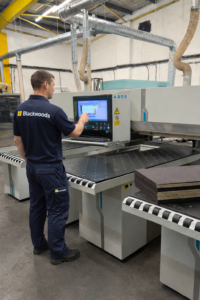
We can cut sheets upto 4.5m x 4.5m

Accuracy & Tolerances

We take care to cut precisely, with a cutting tolerance of ±0.3 mm.
To make sure everything fits as expected, please double-check all measurements before ordering — once a board is cut, it can’t be returned to stock.

Helpful tip: If your project requires multiple pieces to match, label your measurements clearly and include any grain-direction notes where relevant

We offer flexible ways to get your order completed:

  • Drop-off service – leave your sheets with us and collect later

  • Cut-while-you-wait – perfect for smaller jobs or when you’re on a tight schedule

If you have a larger list of cuts or a time-sensitive job, get in touch ahead of time, and we’ll advise on the best option.